
Stitched vs Unstitched Mousepad Edges Compared
May 5, 2026
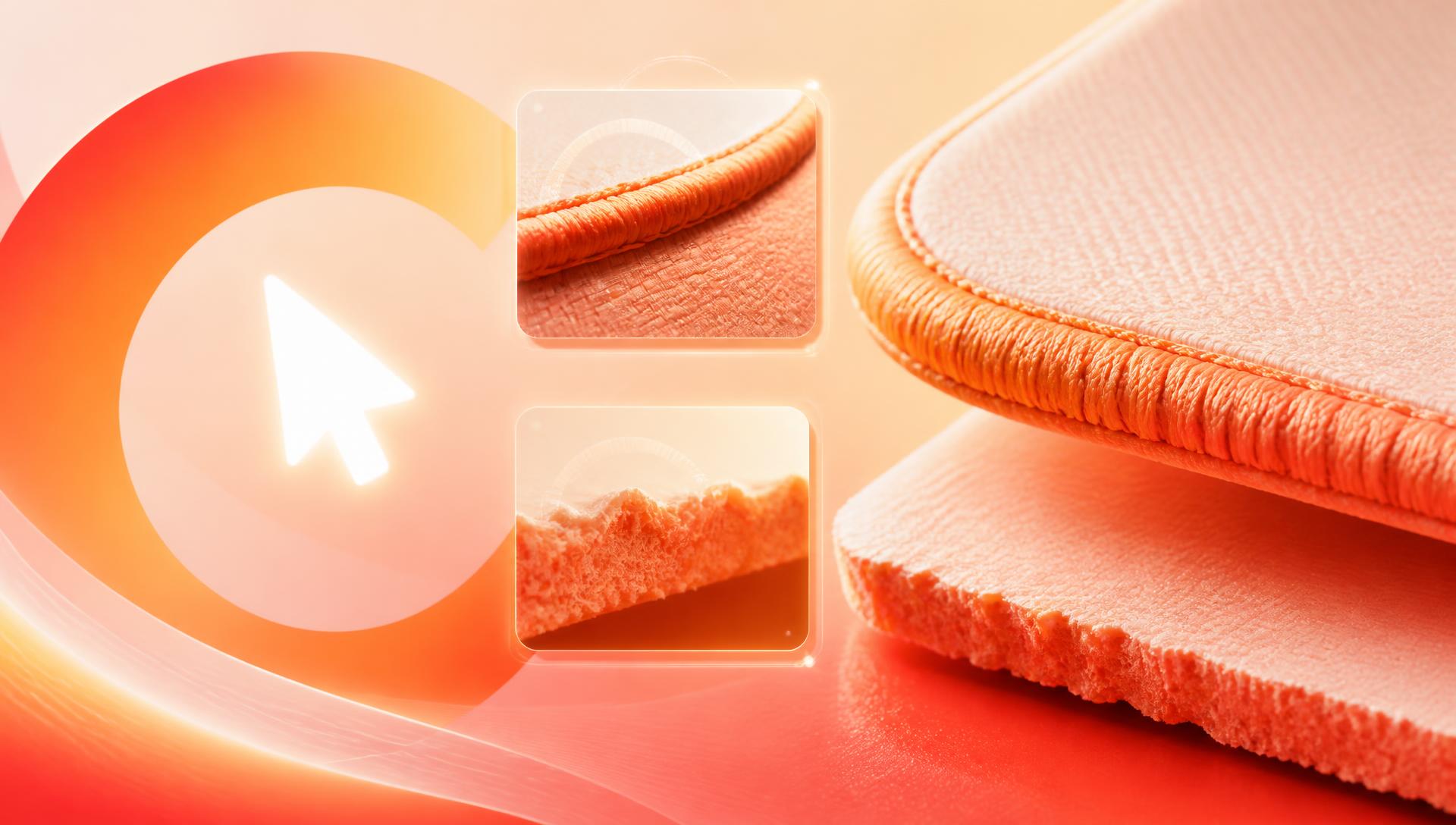
Stitched edges beat unstitched edges on every measure that matters over time: fraying, delamination, wrist comfort, and total cost per year of use. Two mousepads can look identical in a product photo and last wildly different amounts of time, and the edge is almost always why. Here's what stitching actually does, how to spot the difference before you buy, and what happens to each type over months of real use.
What "stitched" actually means
A stitched mousepad has a polyester thread border sewn around the entire perimeter, running through both the cloth top and the rubber base and locking them together as one piece.
An unstitched pad is just cloth and rubber glued together, then cut with a hot knife or heat-sealed at the edge. The layers stay separate — you can usually see them as two distinct materials if you look closely at the edge, rather than one bonded strip.
Cheap heat-sealed edges are the more common version of "unstitched" you'll actually encounter: a melted-plastic-looking perimeter that looks fine in a listing photo and for the first few weeks of use.
How unstitched pads fail over time
The failure isn't sudden. It's a slow structural collapse that starts at the corners — the highest-stress point on any pad — and spreads.
At 6 months, both pad types can still look nearly identical to a casual glance. On an unstitched pad, the corners have usually started to fray very slightly, and cleaning takes a bit more care since a damp cloth can worsen a raw edge.
At 1 year, the gap becomes visible. Unstitched corners curl upward. Fraying spreads from the corners along the edges. A stitched pad, by contrast, still sits flat, with at most minor cosmetic wear on the visible thread.
At 2 years, it's not subtle anymore. On an unstitched pad, the rubber base and cloth top begin delaminating — literally separating from each other — because the edge that used to hold them together as one unit has opened up. The pad shifts around on the desk because the base is no longer fully bonded, edges are fuzzy and soft, and most people replace it around this point. A stitched pad is typically still structurally identical to day one; the stitch thread may show wear if it's been dragged across rough surfaces, but the core bond hasn't failed.
Why the edge is what fails, not the middle
A mousepad is a laminate: cloth top, foam or fabric middle layer, rubber base. Nothing bonds those layers together at the edge except whatever finishing method was used there. The face of the pad barely wears at all under normal mouse friction — the printed surface is dye-sublimated into the fibres, not sitting on top of them, so it doesn't crack or peel with use.
The edge is different. It's handled constantly — picked up, repositioned, dragged across a desk, brushed by a sleeve — and it's the one place where the laminate stack has no reinforcement unless something is specifically added. Stitching is that reinforcement. Once an unstitched edge opens even slightly, moisture, friction, and flexing keep working the gap wider, and the whole pad starts coming apart over the following months rather than staying stable.
This is also why a thicker unstitched pad isn't automatically better: a 5mm unstitched pad will still degrade faster at the edge than a 3mm stitched one, because thickness doesn't address the actual failure point. For more on how thickness and edge quality interact, see the mousepad thickness guide.
Stitch density and thread quality
Not all stitching is equal, and this is where a lot of "stitched" pads still cut corners.
- Stitch density — roughly 6–8 stitches per inch is a reasonable tight, even standard. Sparse, widely spaced stitching leaves gaps that can start unraveling the same way an unstitched edge does, just more slowly.
- Thread coverage — good stitching wraps both the top cloth and the bottom rubber in the same pass, locking the whole stack together. Some cheap pads only stitch through the top layer for appearance, leaving the rubber base still just glued on underneath.
- Corner handling — corners are the highest-stress point on the whole pad. No skipped stitches, no thinning of the thread, no visible gaps right at the corner.
- Thread material — a durable polyester thread that either matches or intentionally contrasts with the pad's colourway, rather than a random or mismatched thread that suggests it was an afterthought.
If a seller doesn't show a close-up photo of the edge, that's worth noticing. The edge tells you more about how a pad is actually built than any spec sheet claim does.
Why the edge affects wrist comfort, not just durability
Edge quality isn't purely a longevity issue — it changes how the pad feels under your wrist and forearm from day one.
A raw or heat-sealed edge is often slightly rigid or has a faint ridge where the layers were cut and sealed. As it starts to fray or curl, that ridge becomes more pronounced, and a curling corner can dig into your wrist or forearm during long sessions. A stitched edge, by contrast, has a small, soft, rounded thread border that sits flat against the desk and stays that way, so the comfort you get on day one is close to the comfort you still get a year later.
How to inspect a pad before buying
You can catch most of this before the box ever arrives:
| What to check | Stitched | Unstitched / heat-sealed |
|---|---|---|
| Edge appearance in photos | Visible thread pattern, slight raised border | Glossy, plasticky, perfectly flat with no visible thread |
| Listing language | Explicitly says "stitched edge" | Vague — "finished edge," "durable border," or no mention |
| Corner close-ups | Even stitching through corner, no gaps | Often smoothed or blurred in photos — a tell in itself |
| Feel description | Soft, slightly raised, rounded | Rigid, flat, sometimes described as "sleek" |
| Base coverage | Thread visible wrapping to the underside | Rubber edge visibly separate from the cloth top |
If you can't see stitching in any listing photo, the safe assumption is that there isn't any.
The long-term cost comparison
An unstitched pad is often a few dollars cheaper up front, but the comparison changes once you account for replacement.
| Stitched | Unstitched | |
|---|---|---|
| Typical usable life on a daily-use desk | Multiple years, condition stable | Around 1–2 years before edge failure affects usability |
| Replacements needed over 3 years | Usually none | Potentially 1–2 |
| Wrist comfort over time | Stable | Degrades as corners curl |
| Desk stability | Stays flat, doesn't shift | Can shift once base delaminates |
Paying slightly more once for a stitched edge is usually cheaper than paying less twice for an unstitched one, and it avoids the mid-life period where a curling, fraying pad is annoying to use but not yet bad enough to justify replacing.
When unstitched is actually a reasonable choice
Stitching isn't a mandatory feature for every use case. For a pad you know you'll replace within 6 months anyway — event giveaways, a temporary desk, a kid's setup — an unstitched pad is a perfectly reasonable, lower-cost option. The calculation only tips toward stitched once a pad is meant to live on your main desk for the long term.
Every CursorCulture pad ships with stitched edges as standard across XL, XXL, and XXXL sizes, for exactly the reasons above — the manufacturing cost difference per pad is small, and the durability difference is not. You can design one from scratch in the studio and see current sizing and pricing on the pricing page.
FAQ
Do stitched edges actually matter on a mousepad?
Yes. The edge is where the cloth top and rubber base bond together, and it's the part of the pad handled most roughly — picked up, dragged, flexed. Stitching reinforces that bond; without it, the edge is the first and fastest point of failure.
How long before an unstitched mousepad starts fraying?
Light fraying at the corners often starts becoming visible around the 6-month mark of regular use, with noticeable curling and spreading fray by around a year, and full delamination possible by two years.
What does mousepad delamination look like?
The cloth top and rubber base separate from each other, usually starting at an already-frayed edge. The pad may shift on the desk because the base is no longer fully bonded underneath, and the edges look fuzzy or soft rather than clean.
How can I tell if a mousepad has stitched edges before buying it?
Look for a visible thread pattern and a slightly raised border in product photos, and check the listing explicitly says "stitched." A perfectly flat, glossy edge with no visible thread is almost always heat-sealed rather than stitched.
Is a thicker mousepad more durable than a stitched one?
No — thickness and edge construction solve different problems. A thick unstitched pad will still fray and delaminate at the edge over time; a thinner stitched pad stays structurally intact. See the mousepad thickness guide for how the two factors interact.
Is it ever fine to buy an unstitched mousepad?
Yes, for short-term or low-stakes use — event giveaways, temporary desks, or a pad you plan to replace within 6 months anyway. For a pad on your main desk long-term, stitched is worth the small extra cost.
Do stitched edges make a mousepad more comfortable, or just more durable?
Both. A stitched edge is soft and rounded and sits flat under your wrist from day one, and it stays that way. An unstitched edge can develop a rigid ridge or curl as it wears, which becomes noticeable under a resting wrist or forearm during long sessions.
Build a pad that's built to last
If you're designing your next mousepad or deskmat, the edge is worth checking as closely as the artwork. Head to the studio to create your design at the size you need, knowing it ships with a stitched perimeter built to hold up for years rather than months.
Keep going
Like this? Get the next one in your inbox.
New journal posts, prompt packs, and artist drops. No spam, ever.